

InstructorRoyed Training
TypeOnline Course
Student Enrolled14
(1 ratings)
Price$390 / 33150 INR.
Buy NowBook Now
Loading
Loading
AI in Regulatory Affairs

Description

Course Format

Key learning Objectives

Who should enroll

Uniqueness of training

Related Courses

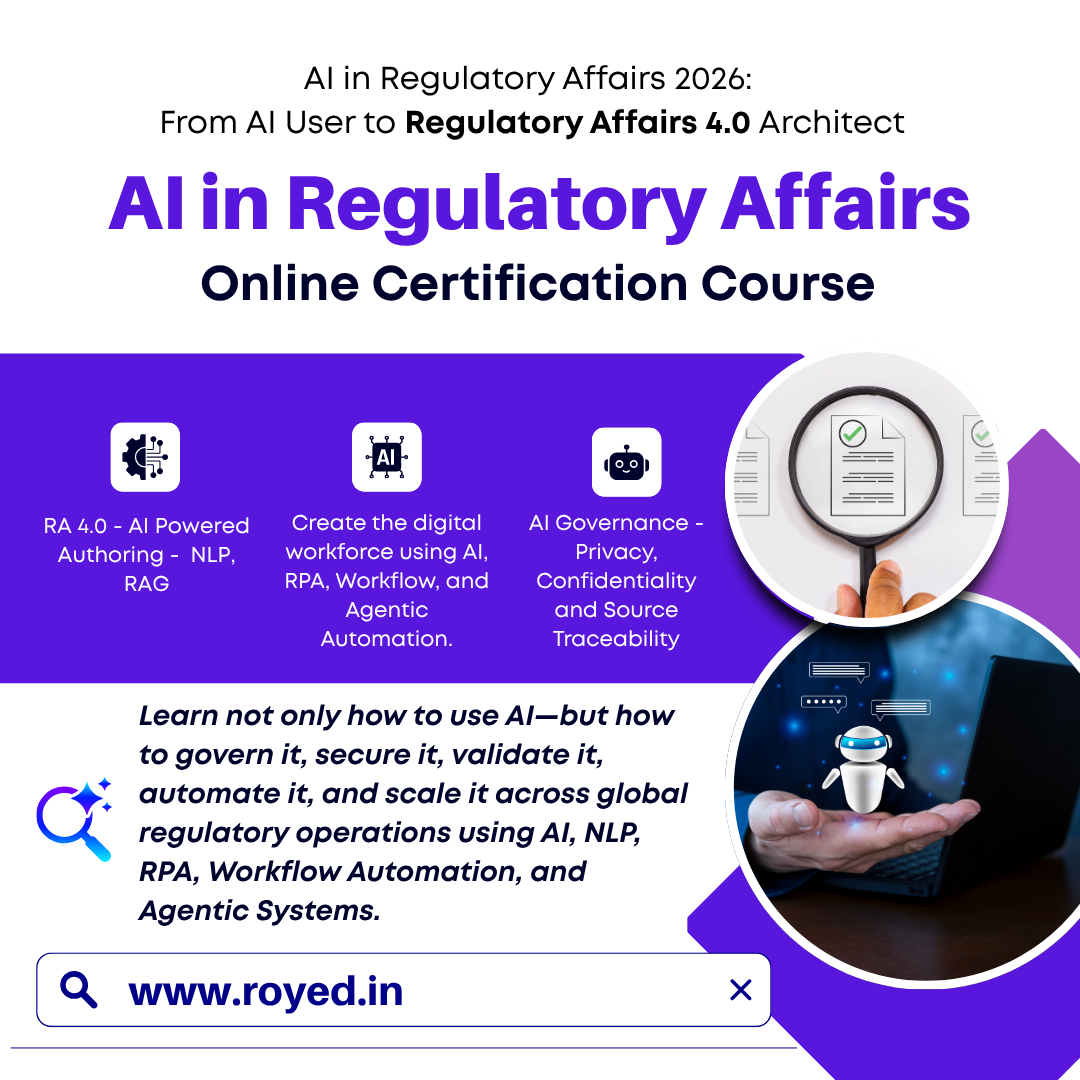
The AI in Regulatory Affairs Online Certification Course is designed to equip regulatory, quality assurance, and operations professionals with practical knowledge and application-focused skills in Artificial Intelligence (AI), Machine Learning (ML), and Natural Language Processing (NLP) within regulatory workflows. The course focuses on how AI is transforming regulatory operations—from dossier compilation and labeling review to global intelligence tracking, compliance monitoring, and real-world evidence submission.

Through detailed lectures, simulations, and real-world case studies, learners will gain hands-on exposure to how AI tools are applied across the drug lifecycle. The program is ideal for professionals seeking to work with or supervise AI systems in a compliant, efficient, and audit-ready manner.

No Prior Coding or AI Experience Required

AI RA Course Snapshots:

  • Course Code: RYD-135
  • Title of the course: Advanced Certification in AI in Regulatory Affairs (ACAiRA)
  • Duration: 1 Month.
  • Nature of the course: Online learning course. So the course can be accessed online anywhere 24×7.
  • Eligibility : Graduation in any discipline. Even final year graduation students can apply.
  • Course Certificate: Certificate will be provided at the end of the successful completion of the course.

Whether you’re involved in authoring, CMC compliance, submission management, pharmacovigilance, or regulatory intelligence — this course empowers you to drive efficiency, accuracy, and innovation in your regulatory processes.

Course Format & Structure:

Elearning Lectures. Each Lecture Includes:

  • Real-World Simulation
  • Case Study
  • Self Assessment Tests
  • Downloadable Handouts

Key Learning Objectives:

  • Understand the fundamental concepts of AI, ML, and NLP relevant to regulatory affairs.
  • Identify areas of regulatory operations where AI can enhance efficiency and accuracy.
  • Learn how to validate, supervise, and interpret AI outputs in document review, dossier assembly, labeling compliance, and post-marketing surveillance.
  • Gain practical experience through simulations that demonstrate AI workflows.
  • Build confidence in interacting with AI platforms, tools, and governance processes.

Who Should Enroll?

  • Regulatory Affairs Professionals
  • Quality Assurance and Compliance Managers
  • Regulatory Operations and Submission Publishing Teams
  • Pharmacovigilance and Post-Marketing Surveillance Teams
  • Project Managers and Business Analysts in Pharma
  • IT and Digital Transformation Professionals working in life sciences

Why This Course is Unique?

1️⃣ Industry-Centric, Not Just Theoretical

Unlike generic AI courses, this program is custom-built for the pharmaceutical, biopharmaceutical, medical device, and healthcare sectors. Every lecture, case study, and simulation is aligned with real-world regulatory scenarios, ensuring practical relevance and job-ready skills.

2️⃣ End-to-End Regulatory AI Skillset

The course provides a comprehensive journey across the regulatory lifecycle—from drug development to post-marketing surveillance—by integrating AI at each touchpoint:

  • AI for regulatory document authoring
  • NLP in CCDS and label management
  • RPA for submission automation
  • Machine Learning for regulatory intelligence & compliance analytics

You’re not learning AI in isolation—you’re learning AI for regulatory transformation.

3️⃣ Hands-On Simulations & Case Studies

Every core module comes with interactive simulation exercises and real-life case studies to apply AI tools and techniques in a regulatory environment:

  • Drafting Module 3 (CMC) sections using GPT-based authoring
  • Building an AI-assisted eCTD workflow
  • Automating regulatory query tracking with RPA
  • Using AI for safety signal detection in pharmacovigilance

These simulated tasks mirror what professionals actually do in AI-powered regulatory roles.

4️⃣ Tool Exposure and Platform Guidance

⚙️ Learners are introduced to AI and automation platforms actually used in the industry, such as:

  • GPT/NLP tools for content automation
  • ARRIA NLG for structured narrative generation
  • Veeva Vault & TriloDocs for structured authoring
  • Cortellis & Sinequa for regulatory intelligence
  • RPA platforms for workflow automation

This sets it apart from academic courses that don’t bridge the gap between concepts and tools.

5️⃣ AI + Regulatory Affairs Integration Mindset

The course emphasizes strategic integration of AI:

  • How to bring AI into regulated environments
  • Ensuring regulatory compliance and data integrity with AI
  • Working with human-in-the-loop (HITL) models
  • Building cross-functional alignment between RA, IT, and QA teams

This helps learners think like AI-regulatory leaders, not just tool users.

6️⃣ Future-Focused with Emerging Trends

The curriculum stays ahead by exploring:

  • Generative AI’s role in regulatory writing
  • Ethical considerations of AI in regulated industries
  • Impact of evolving global regulations on AI adoption
  • Emerging trends in AI audit trails and compliance mapping

You gain future-proof skills aligned with regulatory digitalization roadmaps.

7️⃣ Mentor-Driven Learning by RA + AI Experts

The course is developed and guided by regulatory affairs specialists and AI technology consultants, bringing dual-domain expertise. This hybrid instruction ensures you’re learning not just what is technologically possible, but what is regulatorily acceptable.

8️⃣ Self-Paced but Professionally Structured

Learners can progress at their own pace, yet the structure ensures milestone-based learning with:

  • Sectional assignments
  • Self-assessment checkpoints
  • Simulation scoring and feedback
  • Downloadable toolkits

This creates a blended experience of flexibility + accountability.

9️⃣ Royed’s Proven Track Record in Regulatory Training

Royed Training is a trusted name in online pharma education, known for blending:

  • Industry-relevant content
  • Interactive learning design
  • Scenario-based knowledge delivery

The AI in Regulatory Affairs course is built on this foundation, giving learners a unique blend of credibility, clarity, and career impact.

✅ In Summary:

Royed’s AI in Regulatory Affairs Online Course is not just another AI tutorial. It’s a strategic transformation program that blends regulatory expertise, digital innovation, and practical training—designed for professionals who want to lead the future of Regulatory 4.0. ⚡

Regulatory Affairs Training Courses


Course Code

Course

Duration

RYD-135

AI in Regulatory Affairs

1 Month

RYD-080

Life Science Regulatory Affairs (EPLsRA)

1 Year

RYD-077

Drug Biologic Medical Device Regulatory Affairs (EPGDBMRA)

1 Year

RYD-092

International Drug Regulatory Affairs

1 Year

RYD-025

Regulatory Affairs Strategic Planning

1 Month

RYD-097

Food Regulatory Affairs [PG Certification]

1 Year

RYD-062

Food Regulatory Affairs

1 Month

RYD-024

Drug Dossier Preparation and Filing

1 Month

RYD-098

Regulatory CMC Writing

1 Month

RYD-019

DMF and SMF Preparation

1 Week

RYD-030

ANDA Filing and Strategic Management

1 Week

RYD-094

BA BE Study

3 Days

RYD-064

Stability Study

3 Days

RYD-122

RWE Training

3 Days

RYD-130

Quality Assurance and Regulatory Affairs (Dual Specialization)

1 Year

RYD-101

Pharmacovigilance and Regulatory Affairs (Dual Specialization)

1 Year

RYD-103

Pharma Product Management and Regulatory Affairs (Dual Specialization)

1 Year

RYD-110

Biologic Regulatory Affairs (PGBRA)

1 Year

RYD-115

EU Regulatory Affairs

1 Year

RYD-014

USFDA Regulatory Affairs

1 Month

RYD-006

Medical Device Regulatory Affairs (PGMDRA)

1 Year

RYD-082

US Medical Device Regulatory Affairs

1 Month

RYD-126

EU MDR Training

1 Month

RYD-087

Medical Device Regulation in India

1 Week

RYD-117

MDSAP Training

1 Week

RYD-033

Data Integrity Training

3 Days

RYD-034

483 Observations and Warning Letter

3 Days

RYD-066

Middle East Regulatory Affairs (MERA)

1 Year

RYD-012

GCC Drug Regulatory Affairs

1 Month

RYD-065

Drug Registration and Regulation in Saudi Arabia

1 Month

RYD-031

UAE Drug Regulatory Affairs

1 Month

RYD-040

ASEAN Drug Regulatory Affairs

1 Month

RYD-075

Japan Drug Regulatory Affairs

1 Month

RYD-060

China Regulatory Affairs

1 Month

RYD-067

Africa Pharmaceutical Regulatory Affairs

1 Month

RYD-041

LATAM Drug Regulatory Affairs

1 Month

RYD-068

Brazil Pharmaceutical Regulatory Affairs

1 Month

RYD-127

API Regulatory Affairs

1 Month

RYD-121

Nutraceutical Regulatory Affairs

1 Month

RYD-107

Dietary Supplement Regulatory Affairs

1 Month

RYD-121

Cosmetic Regulatory Affairs

1 Month

RYD-129

US Cosmetic Regulation

1 Week
Section 1Introduction to AI in Regulatory Affairs
Lecture 1Introduction to AI
Lecture 2Basics of AI ML DL | Key Differences | Application in industry
Lecture 3Types of AI
Lecture 4AI Fundamental Session 1
Lecture 5Comprehensive Training on AI Project | Managing Stages | AI Iteration 
Lecture 6How machine learning
Lecture 7Understanding Regulatory Affairs – Traditional vs. Digital | 2 Case Study
Lecture 8Basics of AI for Regulatory Professionals | Understanding different models used in RA | Case Study | Simulation
Lecture 9AI Application across drug life cycle | Case Analysis | Model predictions
Lecture 10AI Terms with Regulatory Significance | Regulatory Applications
Lecture 11NLP in Regulatory Affairs | Conceptual understanding | Usage | NLP in Labeling
Lecture 12Data Grouping with Unsupervised Learning | Case Simulation | Hands on Exercise
Lecture 13Quality Data and Bias | Bias in datasets | Different Types of Bias in Pharma Datasets
Lecture 14AI Data Quality Standard | Checklist
Lecture 15Download AI Data Quality Checklist
Lecture 16Case Study: Accelerated Approval Using Real-World Evidence AI
Lecture 17AI Model for Dossier Submission and Filing - Model Selection | Simulation
Lecture 18AI Technologies in RA
Lecture 19Structured Vs. Unstructured Data | Practical Understanding | Explore Patient Datasets
Lecture 20Sample Data Exercise | Data error | Data Refinement and Cleaning of the data 
Lecture 21Regulatory Affairs V4.0 | Complete Know How
Lecture 22Precision Calibration for Regulatory Ai | Framework | Use Case Identifications
Lecture 23Regulatory AI Tech Stack - Explainer
Lecture 24Advanced Guide to Regulatory AI Maturity
Lecture 25Strategic Mapping : AI in Regulatory Affairs
Lecture 26Architecting HITL - The Governance Framework for AI in Regulatory Affairs
Lecture 27Governing AI in Regulatory Affairs : A Classification Framework
Lecture 28NLP Based Regulatory Document Classification System
Lecture 29The Digital Thread | Document Governance
Lecture 30Concept of Data Lineage and Explainable AI - Explainer 
Lecture 31Data Lineage and Explainable AI Model | Black Box Model | Glass Box Model | 8 Stage Continuous Execution Flow
Lecture 32AI Data Governance in RA | Privacy | Confidential | Data Deidentification | AI Privacy Framework
Lecture 33Mastering NER | How NER Workflow Works in AI RA | Case Based Explainer
Lecture 34Semantic Search in RA 4.0
Lecture 35RAG Foundation on the context of RA 4.0 | End to end of Workflow
Section 2AI in Regulatory Authoring and CMC Writing
Lecture 36AI-Powered Regulatory Document Authoring and CMC Writing
Lecture 37AI Tools Comparison - Authoring and CMC Writing (Module 2 & 3)
Lecture 38Tips for Selecting AI Tools (CMC Authoring)
Lecture 39CMC - AI Workflow Checklist | Simulation Based Cases
Lecture 40HITL Regulatory Document Authoring
Lecture 41Confidence Score in Regulatory Authoring | Case Simulation in CMC Authoring
Lecture 42Data Extract in Regulatory Writing [Case Simulation]
Lecture 43CMC AI Readiness Playbook | Repository Readiness | Metadata Standard | Eight Step Process
Section 3eCTD Publishing and Advanced eCTD v4.0 Training
Lecture 44Fundamentals of eCTD
Lecture 45eCTD v4.0 Structure and Life Cycle
Lecture 46eCTD Validation | Managing Validation | Tool Types | Types of Error | Validation Error Management
Lecture 47eCTD Validation Tools
Lecture 48eCTD Publishing Cycle
Lecture 49HL7 - Structure and Understanding in the context of eCTD V4.0
Lecture 50Tips and Submission Readiness Checklist
Lecture 51eCTD Submission Checklist Format
Lecture 52Regulatory Publishing Document Control Challenges
Lecture 53Document Control Checklist
Lecture 54Leaf Structure Analysis | Common Error in Leaf Structuring
Lecture 55Formatting Rules Templated and Agency Specification
Lecture 56Versioning for Regulatory Publishing
Lecture 57File Naming Standard
Lecture 58Text Recognition and Optical Character Recognition (OCR)
Lecture 59Versioning File Naming OCR - How they work together
Lecture 60Final Document Assembly
Lecture 61Visual Diagram : eCTD Structure and XML Hierarchy
Lecture 62TOC and CI Management
Lecture 63Initial Submission & Maintenance Submission
Lecture 64Managing Lifecycle Operators - NEW REPLACE DELETE APPEND
Lecture 65eCTD Dossier Lifecycle - Multi Sequence View
Lecture 6610 Year eCTD Lifecycle : Sequence Evolution Diagram
Lecture 67Global Decision Tree - Classifying Post Approval Changes
Lecture 68eCTD Technical Validation | Typical issues | Resolutions
Lecture 69eCTD Validation Readiness Checklist
Lecture 70QC Checklist Design and Pre Submission Review
Lecture 71Submission Gateway | FDA ESG • EMA CESP • Health Canada Portal • PMDA Gateway
Lecture 72Regulatory Publishing Simulation 
Lecture 73Pre-Gateway Submission Review Checklist | Post Submission Confirmation
Section 4Risk and Compliance Management
Lecture 74Data Integrity issues in Pharmaceutical Industry : Detailed Understanding 
Lecture 75Establishment Inspection Report | 483 Observations | USFDA Warning Letter | Handling of FDA inspection | Closing of Warning Letter 
Lecture 76Electronic Batch Record for effective compliance management | Key Understanding | Functionalities | Importance in managing data integrity
Lecture 77RTQs | Response to Queries | How to handle Regulatory Queries  
Lecture 78AI and Data Integrity | Regulatory Documentation | Case Based Learning | Understanding Data Integrity Principles | Application and Use Cases
Lecture 79Cases of data breaches with explanation
Lecture 80Case Based Discussion : Data Breach in AI-Assisted CMC Drafting 
Section 5AI in Regulatory Labelling and Artwork
Lecture 81CCDS Management 
Lecture 82CCDS Management Tools - Native, AI Plus | Key Functionalities
Lecture 83AI Augmented Labelling Compliance System
Lecture 84Label Drift in CCDS Management | Simulation Case Study | AI Based Workflow in Label Drift detection and management
Lecture 85AI Review of Labels, PI and SMPC with help of the Case Based Simulation | 4 Case Simulations 
Lecture 86CCDS Management Case Study | Pregnancy Warning Upgrade Case Study
Lecture 87CCDS Management Case Study | Dosage Section Conflict | Case Based Analysis
Lecture 88Centralized Artwork Operation | Mechanism | Operation Step Planning 
Lecture 89Case Study on Centralized Artwork Operation  [Ref: Recall Management]
Lecture 90Artwork Management Terms | Key Understanding on Terminologies | Usage in Artwork Cases
Lecture 91Source Documents | Artwork Brief
Lecture 92Creating and Reviewing Label Content | Stakeholders of Labelling and Artwork Management | Case Studies 
Lecture 93Change control process for labels | Types of changes | Impact Assessment | Concept of Greyzone Changes 
Lecture 94Label Impact Assessment Checklist
Lecture 95Packaging Types & Their Impact on Artwork 
Lecture 96Design tool used in artwork | Esko Platform | Adobe Illustrator | CorelDRAW | File Format | Label Design Workflow and Tool Utilization 
Lecture 97Labelling Management System (LMS) | Understanding of Popular LMS Softwares | Workflow Management | Workflow Automation & Version Tracking | Best Practices
Lecture 98Concept of eLabel (Electronic Labeling) in Pharmaceuticals
Section 6Real World Evidence and Real World Data | Strategic Decision Making
Lecture 99Evidence Based Decision Making | Combine evidences for decision making | Do we need more evidence? 
Lecture 100RWD and RWE | Potential sources of RWE | Traditional RCTs vs. RWE | Case Study - RWE Programs | Influencing HCP decision-making
Lecture 101RWD and RWE in Product Lifecycle Management
Lecture 102RWD and RWE - Fit to use | Assessment 
Lecture 103RWD data sources | Different types | Detailed understanding of each class 
Lecture 104RWD Study Design
Lecture 105RWE Published Tool | Insights on commonly used tools
Lecture 106Healthcare Reimbursement Models : Value Based Care | Fee for Service (FFS) Model | Other Reimbursement Models
Lecture 107Consensus Narrative Review 
Lecture 108Electronic Patient Data | EMR | EHR | Differences | Software architecture and characteristics
Lecture 109Active Surveillance Schemes | Active Case Finding |Sentinel Surveillance | Cohort Studies | Vaccine Safety Surveillance | Pharmacovigilance Programs | Disease Registries |Event Monitoring
Lecture 110RWD Characteristics
Lecture 111RCT vs. RWE Comparison | Case Based Analysis
Lecture 112RCT and RWE Comparison
Section 7Working on Healthcare Datasets
Lecture 113Introduction to Healthcare Datasets
Lecture 114Dataset 1: Claims Data (Insurance)
Lecture 115Dataset 2: Retail Pharmacy Prescription Data
Lecture 116Dataset 3: Longitudinal Patient Data
Lecture 117Characteristics of Different Set of Healthcare Data
Lecture 118Reimbursement and Pricing Datasets
Lecture 119RWE Data Sources & Quality Considerations Checklist | Case Based Analysis
Lecture 120Triangulation and benchmarking | Enhancing Data Validation Through Cross-Referencing
Lecture 121RWD & RWE Case Database
Lecture 122RWE Large Dataset for Data Crunching Exercises |Data cleaning & preprocessing | Comparative Effectiveness Analysis 
Section 8AI Tools, Ethics and Future Landscape
Lecture 123AI Reg Tools - Review | Understanding Capabilities
Lecture 124Regulatory Authority View on AI Adoption
Lecture 125Data Sensitivity | Levels | Consequences | Management
Lecture 126Governance Flowchart – AI Tools in GxP Environments
Section 9AI Tools
Lecture 127RA Example - Generalist Vs. Specialist AI Tools
Lecture 128RA Specific Examples - AI Generalist Vs. AI Specialist Tools
Lecture 129Horizontal vs Vertical AI Tools
Lecture 130AI Tool Assessment Test 
Lecture 131Citation Verification Workflow | AI Tools Management | Hallucination and HITL Action Plan 
Section 10Prompt Engineering
Lecture 132Prompt Engineering – Basic Foundations of Prompt Writing | Different Prompt Framework | Case Based Examples
Lecture 133Special Prompting Structure - Case Based Prompt Designing 
Lecture 134Special Prompting Structure - Case Based Prompt Designing 
Lecture 135PE04 Workflow for writing AI Prompts with Life Science Industry Use Cases
Lecture 136PE06 PE Parameters | Controlling Creativity, Accuracy, and Output Behavior for Life-Science Applications | Simulation based decision making
Lecture 137How to adjust the parameters | Techniques 
Lecture 138Creating A Detailed Regulatory Prompt | Designing Structured Prompt in Code Editor
Section 11Request for course certificate
Lecture 139Final Examination
Lecture 140Request for Course Certificate